A CNC machine is a machine tool controlled by a computer program. Instead of relying on an operator to move the cutting tool manually, the machine follows programmed instructions to complete milling, drilling, turning and other machining operations.
CNC stands for Computer Numerical Control.
Today, CNC machines are essential equipment in automotive manufacturing, aerospace, electronics, medical devices, industrial equipment, die casting mold production and many other industries.
But before CNC technology existed, almost every machining movement had to be controlled by hand.
In this article, we explain what a CNC machine is, how CNC technology developed, how it differs from traditional manual machining, and why CNC machining is important in die casting and mold manufacturing.
- What Is a CNC Machine?
- How Machining Worked Before CNC
- Why Manual Machine Tools Were Limited
- The Birth and Development of CNC Technology
- Manual Machining vs CNC Machining
- What Is the Difference Between NC and CNC?
- How Does a CNC Machine Work?
- CNC Machining in Die Casting and Mold Manufacturing
- CNC Machining at Cast Mold
- Conclusion
- Aluminum Die Casting Services
What Is a CNC Machine?
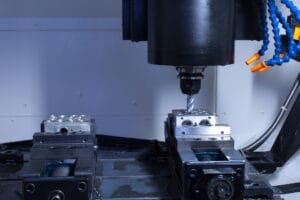
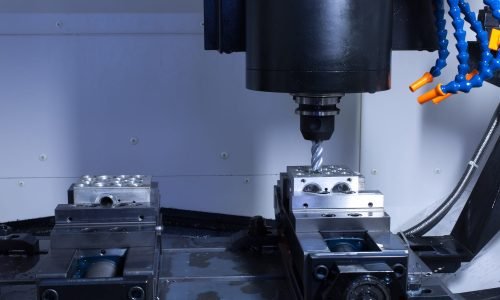
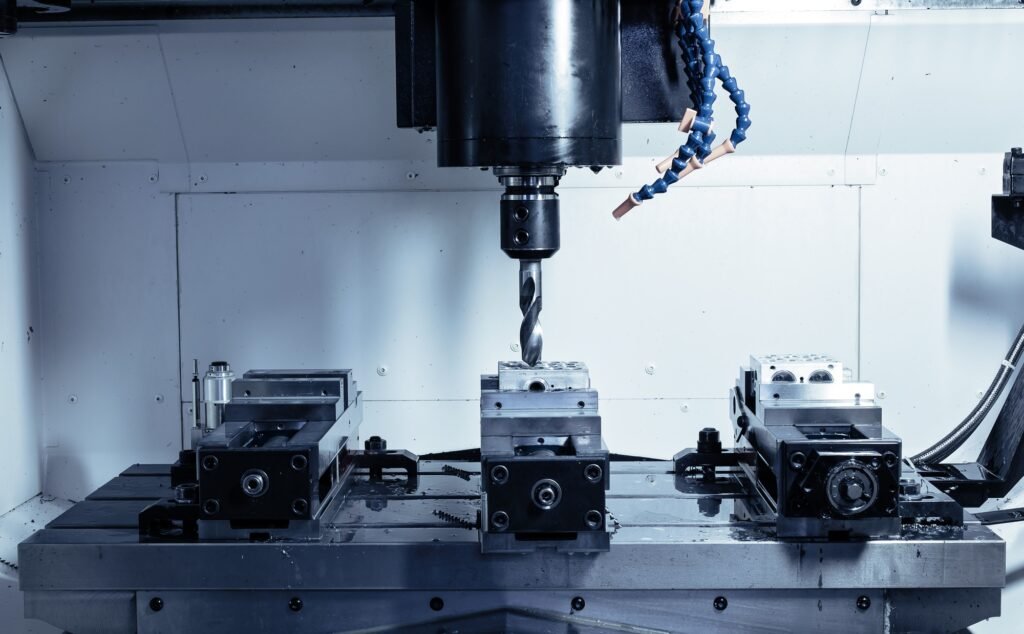
A CNC machine is a machine tool that uses computer instructions to control the movement of the cutting tool, worktable and other machine components.
The program tells the machine:
- Where the cutting tool should move
- How fast the tool should move
- How fast the spindle should rotate
- How deep the tool should cut
- When the tool should start or stop
- When a tool change is required
Depending on the machine configuration, a CNC machine can perform operations such as:
- Milling
- Turning
- Drilling
- Tapping
- Boring
- Reaming
- Contour machining
- Three-dimensional surface machining
Because the machine follows a programmed toolpath, it can repeatedly manufacture parts with consistent dimensions and complex geometries.
How Machining Worked Before CNC
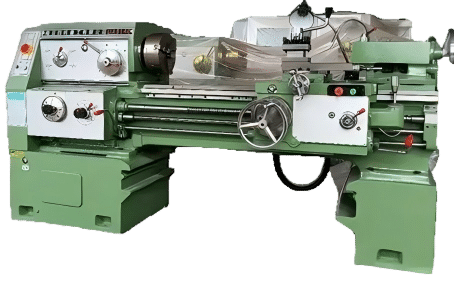
Before CNC machines were widely used, manufacturing companies mainly relied on conventional machine tools, including:
- Manual lathes
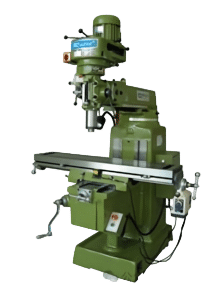
- Manual milling machines
- Manual drilling machines
- Manual grinding machines
These machines already had many of the same basic mechanical components found in modern CNC equipment, such as the spindle, worktable, cutting tool and machine axes.
The main difference was the control method.
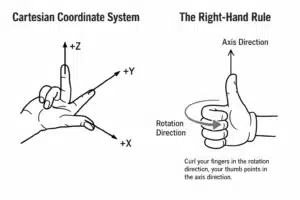
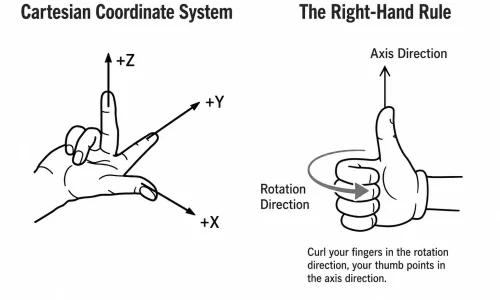
On a traditional manual machine, the operator controlled movement by turning handwheels and reading graduated dials. The operator had to manually control the X, Y and Z directions while judging cutting depth, feed rate and dimensional accuracy.
A highly experienced machinist could produce very accurate parts using this method. However, the final quality depended heavily on the operator’s skill, concentration and experience.
Why Manual Machine Tools Were Limited
Manual machining played an important role in industrial development, but it had several limitations.
Lower Production Efficiency
Every cutting movement had to be performed or monitored by the operator.
When machining a complex component, the operator needed to remain highly focused throughout the entire process. This increased labor requirements and limited production speed.
Inconsistent Part Quality
Even when the same operator manufactured the same part, small dimensional differences could occur between the first part and the last part.
Differences could become more noticeable when another operator took over the process.
Difficulty Machining Complex Shapes
A complex curved surface may require two or more machine axes to move simultaneously and precisely.
This type of coordinated movement is extremely difficult to achieve manually. CNC control makes it possible to calculate and control these movements automatically.
Heavy Dependence on Skilled Operators
Manual machining relies greatly on the experience of the machinist.
Skilled operators remain valuable in modern manufacturing, but CNC technology allows their machining knowledge to be converted into repeatable programs and standardized processes.
The Birth and Development of CNC Technology
The development of numerical control technology was driven by the demand for more accurate and complex components, particularly in the aerospace industry.
Aircraft structures, turbine components and other high-performance parts could not be efficiently produced in large quantities using only manual machining methods.
1952: The First Numerical Control Milling Machine
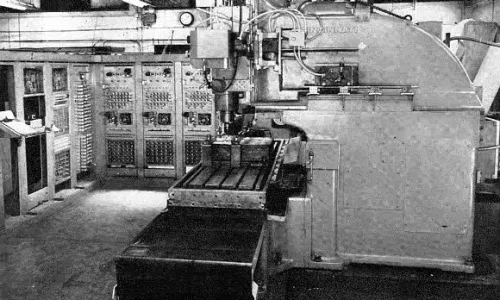
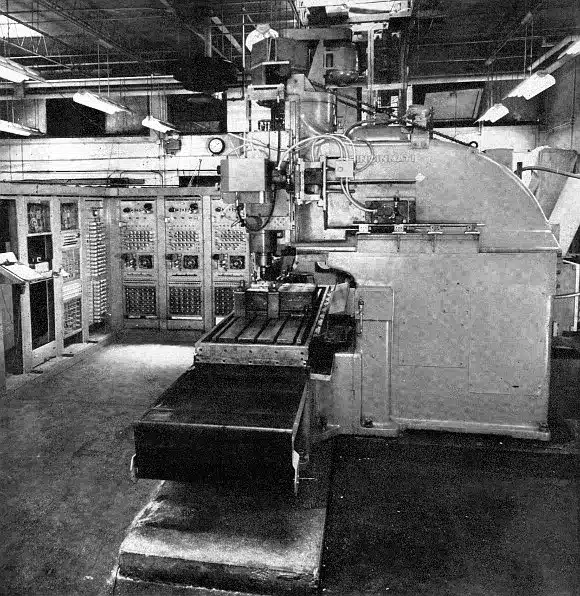
In 1952, the Massachusetts Institute of Technology and Parsons Corporation developed one of the first practical numerical control milling machines.
The system used punched paper tape to store coordinate data.
The machine read the hole patterns on the tape and converted the information into electrical signals. These signals controlled the motors and moved the machine axes automatically.
This is the origin of the term numerical control: numbers and coordinates were used to control the machine’s movement.
1950s–1960s: Early Electronic Control
Early numerical control systems used vacuum tubes and complex electronic hardware.
The systems were large, expensive and mainly used in military and aerospace manufacturing.
1970s: Computers Entered Numerical Control
As smaller computers became available, they gradually replaced many early hardwired controllers.
Programs could be stored and modified more easily, reducing the need to create a new punched tape whenever a machining program changed.
This development established the modern concept of Computer Numerical Control, or CNC.
1980s–1990s: CNC Became Widely Available
Advances in microprocessors significantly reduced the cost and size of CNC control systems.
Specialized CNC control manufacturers developed more reliable and user-friendly systems, allowing CNC machines to enter general manufacturing factories on a much larger scale.
2000s to Today: CNC and Smart Manufacturing
Modern CNC machines offer capabilities such as:
- High-speed machining
- Multi-axis control
- Automatic tool changing
- Tool wear monitoring
- In-process measurement
- Network program transmission
- Production data collection
- Integration with CAD and CAM software
- Automation and robotic loading
CNC machines are no longer only automated cutting machines. They are important production units within modern digital and intelligent manufacturing systems.
Manual Machining vs CNC Machining
| Comparison | Manual Machining | CNC Machining |
|---|---|---|
| Machine movement | Controlled by the operator | Controlled by a computer program |
| Production efficiency | Lower for repetitive production | Suitable for medium- and high-volume production |
| Repeatability | Depends heavily on operator skill | High repeatability after process validation |
| Complex surfaces | Difficult to manufacture | Multi-axis machining is possible |
| Setup cost | Often lower for simple one-off work | Programming and fixture preparation are required |
| Production consistency | More operator-dependent | More stable and standardized |
| Program storage | Not applicable | Programs can be stored and reused |
| Best application | Repair, simple parts and low-volume work | Precision, complex and repeat production |
Manual machining has not disappeared.
It remains useful for repair work, machine adjustment, prototype modification and certain simple components. However, CNC machining provides clear advantages when the project requires repeatability, complex geometry and stable batch production.
What Is the Difference Between NC and CNC?
NC and CNC are related, but they are not exactly the same.
| Item | NC | CNC |
|---|---|---|
| Full name | Numerical Control | Computer Numerical Control |
| Control system | Mainly hardwired electronic control | Computer-based control |
| Program storage | Usually external media such as punched tape | Stored in the controller or transferred digitally |
| Program editing | Difficult and time-consuming | Programs can be edited and optimized |
| Flexibility | Limited | High |
| Network capability | Generally unavailable | Programs and data can be transferred through networks |
| Current use | Mostly historical or specialized systems | Standard technology in modern machine tools |
NC was the early form of numerical control.
CNC developed from NC by introducing computer-based control. This allowed machining programs to be stored, edited, copied and transferred more conveniently.
Today, most equipment referred to as a “numerical control machine” is actually a CNC machine.
It is also important to understand that a machining center is a type of CNC machine, normally equipped with an automatic tool changer and capable of performing multiple machining operations in one setup.
How Does a CNC Machine Work?
Although CNC machines can be highly advanced, their basic working process can be divided into several steps.
1. Review the Part Drawing
The engineering team first reviews the 2D drawing or 3D model.
Important information includes:
- Material
- Dimensions
- Tolerances
- Surface requirements
- Hole and thread specifications
- Datum locations
- Inspection requirements
2. Plan the Machining Process
The engineer determines:
- Which surfaces need to be machined
- The machining sequence
- Workholding and fixture design
- Cutting tool selection
- Cutting parameters
- Inspection methods
3. Create the CNC Program
For simple parts, the program may be written directly on the CNC controller.
For complex parts, CAM software is usually used to create and simulate the toolpath.
The completed program contains commands for machine movement, spindle speed, feed rate, tool selection and other operations.
4. Set Up the Machine
The operator installs the workpiece, fixture and cutting tools.
The correct work coordinate system and tool offsets must also be established.
Incorrect setup can cause dimensional errors, tool damage or even a collision.
5. Run the Machining Program
The CNC controller reads the program and moves the machine axes according to the programmed instructions.
The machine automatically performs the required cutting operations.
6. Inspect the Finished Part
After machining, the part is inspected using suitable measuring equipment.
Depending on the project, inspection may include:
- Vernier calipers
- Micrometers
- Height gauges
- Thread gauges
- Coordinate measuring machines
- Surface roughness testers
- Custom inspection fixtures
CNC Machining in Die Casting and Mold Manufacturing
CNC machining is especially important in the die casting industry.
A die-cast component is formed by injecting molten metal into a steel mold under pressure. Although the casting process can produce near-net-shape parts, CNC machining is still required during both mold manufacturing and component production.
CNC Machining for Die Casting Molds
A die casting mold contains many precision components, including:
- Mold cavities
- Core inserts
- Slides
- Lifters
- Ejector components
- Runner systems
- Overflow areas
- Cooling channels
- Insert pockets
- Parting surfaces
These components must be manufactured with controlled dimensions and accurate alignment.
CNC milling, drilling, grinding, EDM and wire cutting may all be used during the mold manufacturing process.
The accuracy of the mold directly affects:
- Casting dimensions
- Parting-line mismatch
- Flash formation
- Surface appearance
- Assembly performance
- Mold life
- Production stability
CNC Machining for Die-Cast Parts
Die casting can produce complex metal parts efficiently, but certain features are normally completed after casting.
Typical CNC-machined features include:
- Precision holes
- Threaded holes
- Bearing positions
- Sealing surfaces
- Assembly datums
- Connector interfaces
- Flat mounting surfaces
- High-tolerance diameters
For example, an aluminum die-cast housing may be cast with its main external shape, ribs and internal structure. CNC machining can then be used to finish the sealing face, drill mounting holes and machine threaded connections.
This combination provides the production efficiency of die casting and the dimensional accuracy of CNC machining.
Why Process Planning Matters
CNC machining should be considered during the early DFM stage rather than after the mold has already been completed.
The engineering team should evaluate:
- Machining allowances
- Casting datums
- Fixture locations
- Clamping deformation
- Porosity risk in machined areas
- Tool access
- Machining sequence
- Inspection requirements
Correct planning can reduce machining time, scrap rates and unnecessary production costs.
CNC Machining at Cast Mold
At Cast Mold, CNC machining supports both die casting mold manufacturing and the secondary machining of aluminum and zinc alloy die-cast components.
Our integrated manufacturing process can include:
- DFM review
- Moldflow analysis
- Die casting mold design
- Mold manufacturing
- Mold trial and sampling
- Aluminum or zinc die casting
- CNC machining
- Surface finishing
- Inspection and packing
By considering casting, tooling and CNC machining together, we can identify potential manufacturing risks earlier and develop a more stable production process.
Conclusion
A CNC machine uses computer programs to control machine movements and cutting operations.
Compared with traditional manual machining, CNC technology provides better repeatability, higher production efficiency and the ability to manufacture more complex components.
The development from early numerical control systems to modern multi-axis CNC machining has played an important role in the growth of precision manufacturing.
In die casting production, CNC machining is used not only to manufacture accurate molds but also to finish critical features on aluminum and zinc alloy castings.
For the best results, die casting, mold design and CNC machining should be evaluated as one complete manufacturing process.
Aluminum Die Casting Services
Learn more about our aluminum high pressure die casting services in China.